

If you're reading this, chances are you're in the middle of something hard. A divorce that's turned adversarial. A business partnership that's unraveling. A landlord-tenant dispute that's dragged on too long. A workplace conflict that's escalated past the point of a simple conversation. Wherever you are in it, you're probably asking the same question a lot of our clients ask: does this really have to go to court?
The answer, more often than you might think, is no.
What ADR Actually Is
Alternative Dispute Resolution — ADR — is an umbrella term for the ways people resolve conflict outside of a courtroom. Mediation is the most common form, but ADR also includes arbitration, negotiation, and in family matters, tools like supervised visitation that help families navigate transitions safely while a resolution takes shape.
At its core, ADR is built on a simple idea: the people closest to a conflict are often in the best position to help shape its resolution, with the right support and structure around them.
Litigation Wasn't Built for Healing
Courts serve an essential purpose. But they're built for determining legal rights and obligations — not for preserving relationships, protecting children from ongoing conflict, or helping two people find a workable path forward. Litigation is, by design, adversarial. It asks each side to build the strongest possible case against the other.
That structure works when a clear legal ruling is truly what's needed. But for many disputes — a custody arrangement, a business dissolution, a neighbor dispute, a workplace grievance — the adversarial process can leave lasting damage long after the judgment is entered.
What ADR Offers That Litigation Often Can't
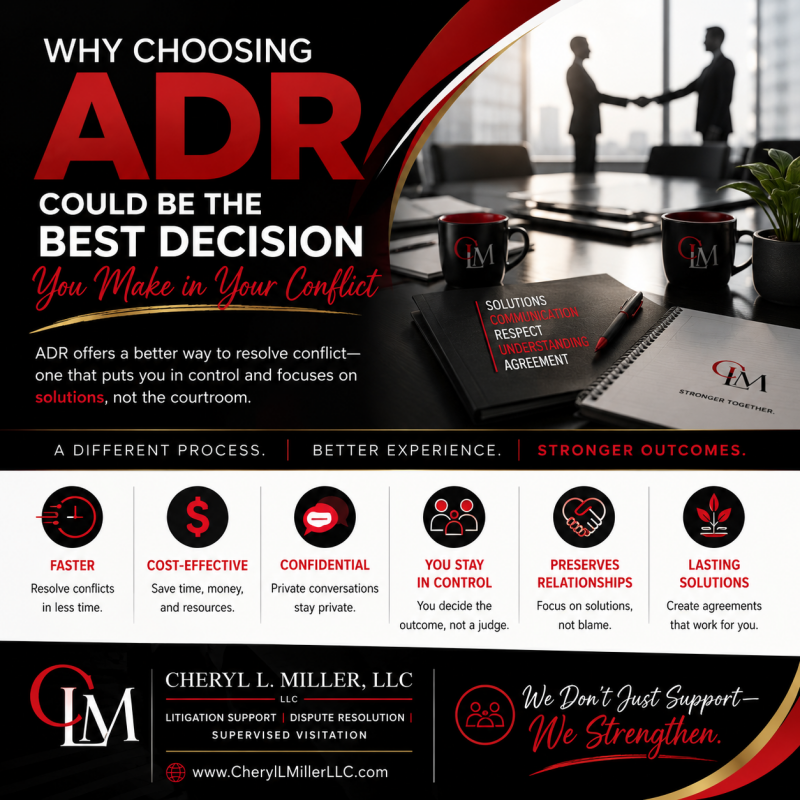
Time. Court dockets move on the court's schedule, not yours. Mediation can often be scheduled within weeks, and many disputes resolve in a single session or a short series of them.
Cost. Discovery, motions, hearings, and trial preparation add up quickly. ADR typically requires a fraction of the time and expense, which matters whether you're an individual, a family, or a business trying to control legal spend.
Privacy. Court proceedings are part of the public record. Mediation is confidential. For families, businesses, and professionals concerned about reputation or sensitive information, that privacy can matter as much as the outcome itself.
Control. In litigation, a judge decides. In mediation, you and the other party — with guidance from a neutral mediator — decide together. People are far more likely to follow through on an agreement they helped shape than one that was imposed on them.
Relationships. Not every conflict ends the relationship. Co-parents still have to co-parent. Business partners sometimes still need to work together. Neighbors still live next door to each other. ADR is designed to resolve the dispute without destroying what has to continue afterward.
Where This Matters Most: Families in Transition
Our Dispute Resolution division was built with this in mind. Family conflict is rarely just a legal issue — it's a human one. That's why our approach to mediation and supervised visitation is child-centered and trauma-informed from the start. When children are involved, the goal isn't just a resolved case file. It's a family that can move forward with as much stability, safety, and dignity as possible.
Supervised visitation, in particular, exists to protect that stability while legal matters are still being sorted out — giving children safe, structured contact with a parent while the court process continues, without forcing a family to wait in limbo.
ADR Isn't a Compromise on Justice — It's a Different Path to It
Choosing mediation or another form of ADR isn't giving up on a strong resolution. It's choosing a process that's often faster, less expensive, more private, and more likely to produce an agreement both sides can actually live with. For many people in conflict, that isn't a lesser outcome — it's a better one.
If you're weighing your options — whether you're an attorney advising a client, or someone standing in the middle of a dispute yourself — it's worth asking whether ADR could get you to resolution with less cost, less time, and less collateral damage than litigation.
Ready to talk through your options? Our Dispute Resolution & Supervised Visitation team is here to help families, individuals, workplaces, and communities find a path to resolution outside the courtroom.
📞 Call: 573-238-8130 📧 Email: admin@cherylmillerllc.com 🌐 Visit: www.CherylMillerLLC.com
Cheryl L. Miller, LLC is not a law firm and does not provide legal advice. Our Dispute Resolution division provides ADR, mediation and supervised visitation services; individuals seeking legal advice or representation should consult a licensed attorney in their jurisdiction.
Add comment
Comments