

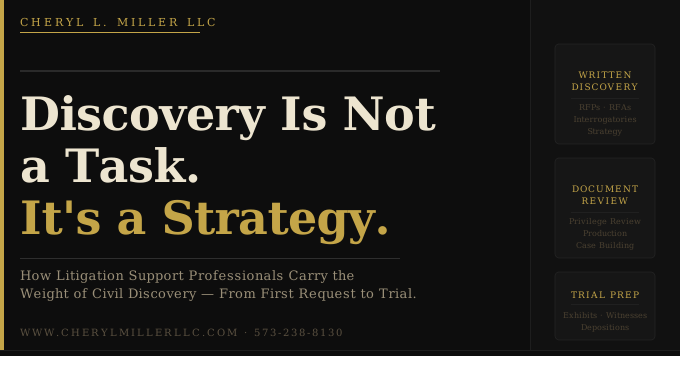
Civil litigation is won and lost in the middle. Not at intake, where the facts are still fresh and the theory of the case feels clean. Not at trial, where the story is finally told. In the middle — in the months of discovery that determine what evidence exists, how it is organized, how it is presented, and how well-prepared the legal team is when it matters most.
Discovery is where the case becomes real. It is also, by any objective measure, the most labor-intensive phase of civil litigation — a sustained, overlapping series of deadlines, document obligations, strategic decisions, and procedural requirements that demands consistent, skilled attention from beginning to end. This is the work that litigation support professionals are built for. Not as a backup function. As a core part of the litigation team.
What Discovery Actually Involves
It is worth naming, specifically, what discovery encompasses in a civil matter — because the scope is often underestimated until a firm is inside it.
Written discovery encompasses interrogatories, requests for production (RFPs), and requests for admission (RFAs). Each requires not just response, but strategy — understanding what the other side is looking for, drafting requests designed to get what you need, and responding in ways that are accurate, complete, and strategically sound. This is document work that requires legal knowledge, writing skill, and careful attention to what is being said and what it could mean later.
Document review and production is where volume becomes the defining challenge. Responding to RFPs means gathering, reviewing, and producing documents — and depending on the matter, that could be 500 pages or 500,000. Every document must be reviewed for relevance, responsiveness, and privilege before production. That review, done well, is also where the case is built: the documents that tell the story, the timeline that emerges from the record, the inconsistencies that need to be addressed before the other side finds them.
Electronic discovery (e-discovery) has become its own discipline within litigation. The volume of digital information involved in modern disputes — email chains, messaging platforms, cloud storage, metadata-bearing files, mobile communications — is enormous, and the legal obligations around its preservation and production are real and litigable. Managing ESI requires both technical understanding and a working knowledge of the Rule 26(b)(1) proportionality framework that governs what must actually be produced.
Deposition preparation is one of the most preparation-intensive tasks in litigation. Each deposition requires a comprehensive exhibit file, organized prior testimony, a working understanding of the deponent's role in the underlying facts, and a clear theory of what needs to be established. The deposition record is built once. A well-prepared deposition advances the case. An under-prepared one produces a muddled record that is difficult to recover from.
Expert discovery generates its own layer of document and correspondence management — coordinating with retained experts, managing expert report deadlines, organizing materials for expert review, and preparing for the deposition of opposing experts.
The cumulative demand of managing all of this — simultaneously, across multiple cases, under tight timelines — is where litigation support professionals provide indispensable value.
The Role of a Litigation Support Professional in Discovery
The litigation support professional is not a file clerk. They are not a document retrieval service. They are a trained legal professional who understands the strategic significance of the discovery phase and executes within it at a high level.
Here is what that looks like in practice.
Implementing discovery strategy. Once the attorney has mapped out the discovery strategy — what needs to be established, what the other side is likely to pursue, what the key documents are — the litigation support professional carries that strategy forward. They draft discovery requests built to get what the attorney needs. They draft interrogatory responses that are accurate, appropriately complete, and reflect the legal positions being advanced. They maintain the organizational structure that keeps the discovery phase coherent as volume and complexity grow.
Document organization as case architecture. The documents produced and received in discovery are not just a compliance output — they are the evidentiary foundation of the case. A litigation support professional reviewing and organizing documents in a complex commercial dispute is simultaneously building the factual record: identifying key witnesses, surfacing the timeline, flagging inconsistencies between the documentary record and the client's account, and identifying the documents that will matter most at summary judgment or trial. This work is analytical, not clerical.
Privilege log management. Privilege review requires consistency and precision. Privilege logs assembled without a systematic approach — with inconsistent criteria, inadequate descriptions, or missing entries — invite challenge. A litigation support professional who builds and maintains the privilege log with the rigor the process demands protects the attorney's work product and client communications from exposure.
Deposition support. Comprehensive deposition preparation materials — organized exhibit files, chronological case binders, summaries of prior statements, documents keyed to anticipated examination topics — are what allow an attorney to walk into a deposition prepared to execute, rather than to navigate. Litigation support professionals build these materials. They make the difference between a deposition that advances the theory of the case and one that doesn't.
Deadline and calendar management. Discovery is governed by overlapping deadlines — initial disclosure dates, response deadlines, expert disclosure cutoffs, discovery close dates, and motion practice windows that all require coordination. A litigation support professional who owns the discovery calendar — tracking every deadline across every active matter, flagging approaching cutoffs, and ensuring nothing is missed — is not providing administrative support. They are providing professional risk management.
Hearing and trial preparation. As the case moves toward dispositive motions or trial, the preparation demands intensify. Trial exhibit lists, witness preparation materials, demonstrative exhibits, motion appendices, and courtroom logistics — all of this is document-intensive, time-critical work that requires a dedicated professional whose attention is on that preparation, not divided across the full demands of practicing law.
E-Discovery: Where Specialized Expertise Pays Off
E-discovery deserves specific attention because it is the area where the demands of modern litigation most clearly exceed what a traditional administrative support model can handle.
The Federal Rules of Civil Procedure have addressed ESI preservation and production since the 2006 amendments, with the 2015 amendments further sharpening proportionality standards and the consequences of preservation failures. The legal obligations are well-established. The execution challenge is real.
A litigation support professional with e-discovery experience brings capacity in areas that are genuinely complex:
Source identification. ESI lives in many places — email servers, mobile devices, cloud storage, third-party platforms, and business systems that may not be immediately obvious. Understanding where a client's potentially relevant ESI resides, and ensuring that preservation covers all of those sources, is the foundation of defensible e-discovery practice.
Metadata-preserving collection. ESI collected through informal methods — forwarding emails, printing and scanning, taking screenshots — loses the metadata that may be relevant and that opposing counsel may be entitled to. Proper collection methods that preserve the integrity of the ESI are not a technical nicety; they are a professional obligation.
Proportionality analysis. Not every ESI demand is proportional to the needs of the case. Rule 26(b)(1) provides the framework for pushing back on demands that impose unreasonable cost and burden — but doing so effectively requires both legal knowledge and a working understanding of what the requested ESI would actually cost to collect, review, and produce.
Systematic review. Large-volume document review benefits from an organized, systematic approach — consistent tagging criteria, clear review protocols, quality control mechanisms. A litigation support professional who has managed large document reviews brings that discipline to the process.
What It Means to Have the Right Support in Place
The litigation matters that run most smoothly — where deadlines are met, productions are complete, depositions are well-prepared, and the attorney arrives at dispositive motion practice with a clean, organized record — are the ones where skilled litigation support was present throughout.
This is not a coincidence. Discovery is too complex, too voluminous, and too consequential to manage without dedicated support. The attorney who has a trusted litigation support professional managing the discovery infrastructure is free to do what attorneys are trained to do: think about the law, counsel the client, and make the strategic decisions that shape the outcome of the case.
That partnership — between skilled legal professionals each operating in their area of expertise — is how litigation teams deliver for their clients at the highest level.
How CLM LLC Supports Civil Litigation Matters
At Cheryl L. Miller LLC, our litigation support professionals work alongside attorneys from the earliest stages of discovery through trial preparation. Our team is trained in civil litigation practice, document management, e-discovery principles, and deposition support — and we work in the rhythm of a litigation practice, not as an outside vendor who needs to be managed.
We support solo practitioners who need consistent, reliable capacity on complex matters. We support small and mid-size firms managing high case volumes. And we provide targeted project support for specific phases of a matter — document review, deposition preparation, trial organization — when firms need supplemental capacity for a defined period.
If you are managing civil litigation and want to understand what professional litigation support looks like integrated into your practice, we welcome the conversation.
Cheryl L. Miller, JD is the Founder and Chief Operating Officer of Cheryl L. Miller LLC, a full-service virtual paralegal, litigation support, legal staffing, and dispute resolution firm serving attorneys and law firms nationwide.
📞 573-238-8130 | admin@cherylmillerllc.com | www.CherylMillerLLC.com
Add comment
Comments